Showing posts with label Old Encyclopedias. Show all posts

Saturday, April 23, 2011

Brian Dettmer's Book Art

Brian Dettmer is known as "the Book Surgeon" for his technique of carving up old volumes to create beautiful sculptural art. Taking collage to the next level, he neither adds nor rearranges, only removes using scissors and surgical tools transforming dictionaries, old medical textbooks, and out-of-date encyclopedias into mind-boggling dioramas.

My Modern Met features fifteen illustrations of Dettmer's bibliotransformations as well as an exclusive interview with seven more photos. Visit the website of Brian Dettmer to view additional work dating from 2005 to 2010. Recent press includes an article on The New Yorker's "Book Bench" titled Postmodern Deconstruction. A solo show is scheduled for May 19, 2011 – June 11, 2011 at Kinz + Tillou in New York City.

Tuesday, January 4, 2011

Collage as Gesamtkunstwerk


I'm still reading my way through "The Culture Industry: Enlightenment as Mass Deception" which is a chapter from Dialectic of Enlightenment ( Adorno & Horkheimer, 1944). There I came across a marvelous German word: gesamtkunstwerk.

Translated as" total work of art," the idea of gesamtkunstwerk implies ideal work of art, universal artwork, synthesis of the arts, comprehensive artwork, all-embracing art form, or total artwork. The term was first used in 1827 by the German writer and philosopher K. F. E. Trahndorff. As a "supernaturalist," Trahndorff opposed theological rationalism and embraced the indeducible, supernatural and mystical nature of religious revelation. German opera composer Richard Wagner used the term in his 1849 essays "Art and Revolution" and "The Artwork of the Future", where he speaks of unifying all works of art via the theater.

I see collage as a synthesis of both the visual arts (painting, photography, graphic design, etc.) and of the ephemeral bits of life, memories and dreams; a curio cabinet of the soul.

And, in keeping with the German theme, check out Alexander Korzer-Robinson's amazing collages constructed with the German encyclopaedia Brockhaus Konversationslexikon.

Monday, May 17, 2010

More on Zell's Encyclopedia


Zell's Popular Encyclopedia: A Universal Dictionary of English Language, Science, Literature, and Art - In Two Volumes - New and Revised Edition can be seen on the Internet Archive. It is printed in three columns (my single volume edition is printed in two) and the illustrations are different. Link to Volume II. here.

I see there is a five volume edition (with a price of $1,200.00) and also a 126 page index written by Theodore W. McClintock in 1879 titled: Analysis of Zell's Popular Encyclopedia; Consisting of an Outline of Universal History; the Arrangement in Chronological Order of Historical, Biographical Titles in Zell's; With Synopsis of the History of Each Nation and Tables of Persons.

Friday, May 14, 2010

From Aldwyth to Zell


I recently read about the collage artist Aldwyth and her exhibit organized the Halsey Institute of Contemporary Art in Charleston, South Carolina. The artist is described as "a voracious collector, scrupulous cataloguer, encyclopedic archivist, sly social commentator and corrective art-historian" by artnet Magazine. She sounds like someone I would enjoy talking with!

My curiosity was aroused when I learned that the source for one of her collages was Zell's Encyclopedia. I was lucky to be able to find an inexpensive copy minus its title page. The cover says: Zell's Universal Encyclopedia - New Edition - Self Pronouncing - Unabridged. Data from the United States Census of 1890 is included following 982 pages of alphabetical entries with lovely engraved illustrations.

Friday, February 19, 2010

Marblehead Mass. Free Range Chicks


Back when I first started participating in Marie's postcard exchange, I commented that I had a chicken postcard somewhere. This week I finally found it!


"Marblehead Mass, Dear Sir. In answer to your inquiry will say that I could not make any reduction on larger lots, as my eggs and chicks are booked in advance. If you are in need of an early shipment kindly let me hear from you at an early date. Yours respectfully Chas Robinson."

Glued to the postcard is a newspaper clipping of a classified advertisement reading:
WYKOFF'S STRAIN of S. C. W. Leghorns, all great layers, all have free range and fed nature's way; these eggs hatch chicks that live; $1 set, $5 100; chicks 10 cents; cockerels $2; India Runner duck eggs, $2 11. CHARLES ROBINSON, Marblehead.

Here are a couple of Chicken Plates from my clipping files.


Hope everyone is having a marvelous Postcard Friendship Friday!

Thursday, January 28, 2010

In Studio 2: White Board

So far I've moved in four folding tables, a drawing table, and a cabinet. Plus enough bins to fill the space under the tables. The two smaller back-to-back tables have had their legs extended because I like to work standing up.

A new feature in this room is an 8 foot by 8 foot collage design wall. My friend attached two pieces of "white board" to the wall just inside the door and I have some of those erasable markers. How fun to have such a large surface to draw on. I'm hoping that blue painter's tape will be safe to use on the surface, also. Time will tell!


I got the idea from the quilter, Nancy Crow. Her design walls can be pinned to which makes sense when arranging fabric but I don't want to put holes in my paper. Plus my cat Mica has a penchant for eating thumb tacks and push pins so I tend to avoid them for safety reasons!


I absolutely love Nancy's book, Quilts and Influences published by the American Quilter's Society. Have you seen the whirligigs and tramp art she shows as "influences" at the end of the book?

Wednesday, January 27, 2010

Lawn Tennis & Window Screens


After I don't know how many days of sifting and sorting, I am now all moved in to Studio 2. Here's a couple of re-discovered items that made me think of summer. If you hold your racket like this you will hit like a girl. Hey, wait a minute, I AM a girl!


Look at these cool numbered thumb tacks used back in the days when storm windows and screens had wooden frames.


I'd use them to keep track of all my bins but I've already made new tags for them on the computer in 30 point type so I can find stuff without wearing glasses. I'll post pictures tomorrow after I photograph my newly organized studio in natural light.

Saturday, December 5, 2009

Oh Look, It's the Nylon Lady!

So nice to find the same photograph that I used in my collage titled "Easy to Adjust." I think my attraction might be due to the fact that she resembles my mother.

Tuesday, December 1, 2009

How They Do That


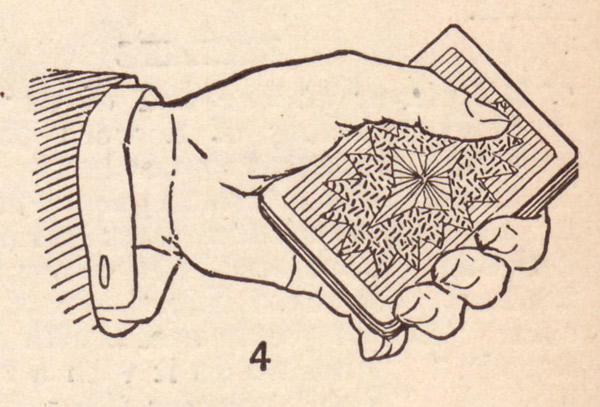
The mystery solved, thanks to the 1923 Book of Knowledge. Very nice hands, playing cards and numbers.


Things To Do

I recently added a Subject Index right below the Blog Archive, and added a few new labels including All My Favorites 2008 and All My Favorites 2009.

Other additions: Methods (how to) and Triangles.

I can see where there is room for improvement here. Sixty three posts labeled "Artists" seems cumbersome and vague. I'll have to work on fixing that.

Here is another cool page from the 1923 Book of Knowledge:

Making paper boxes is a fun thing to do at holiday time!

Monday, November 30, 2009

Anyone Can Play


From the Book of Knowledge 1923, Volume I.
We have all seen this Magic Kingdom, which is in nearly all our homes. We call in the Piano. Whenever I am there, I am so happy that it makes me want to show you the way, and help you to understand all the beautiful things which the Fairies whispered in the days of long ago.

Sunday, November 29, 2009

Best of BoK Volume Nine


These first two plates illustrate an article titled "The Color of the Stars."

The fine print on THE LIGHT THAT EXPLAINS THE STARS TO US reads as follows:
When pure light, as from a white-hot iron, passes through a glass prism, it is broken up into seven colors, called the spectrum, as shown in the first picture. But light from the sun shows, in addition to the colors, various lines, as seen in the second picture. These lines are caused by some of the different substances that compose the sun. Although here we see only a few lines, the sun's spectrum really shows over 2,000 lines. The third picture is the spectrum of a star, Sirius, and when compared with that of the sun, it shows that the stars are made of the same materials as the sun and earth, because the lines in the spectrum for different substances always appear in the same position in relation to each other, as can be seen by comparing these spectra of the sun and Sirius. Although the spectrum color of the metal sodium is yellow, as in the fourth picture, this appears dark in the sun and star spectra, because of the intense light behind it, just as a gas-jet seen in front of the sun's disc appears black; but of course sodium is in the same position in all the spectra.

And HOW THE STAR LIGHT TELLS US OF WHAT THE STARS ARE MADE says:
This picture shows us how the spectroscope is used to enable men to catch the light of a star, and by passing it through a glass prism to bread up the light into various colors. As different metals give off different colors, we can in this way tell of what the stars are made. Ths picture does not show the spectroscope, but illustrates the principle.

This last illustration, A WHEEL A QUARTER OF A MILE ROUND, reminds me of a postcard that was posted recently for Postcard Friendly Friday. The caption reads:
Some of you have seen this gigantic wheel which used to be at Earl's Court in London. This was not the first great wheel to be built. An American engineer, Mr. G. W. Ferris, had seen those curious little upright roundabouts that come to the country fairs, and he thought out the idea and built for the World's Fair at Chicago a big wheel of iron that carried 1,440 people at one time. Then the Earl's Court wheel was built, and this was much more wonderful that the other. It was 300 feet across, and the towers that supported it were 175 feet high. The axle, weighing 54 tons, was hollow, and people could walk through it from one side to the other while the wheel was going round with its 1,600 passengers. The great wheel was turned by a big engine that needed only one man to work it.

1923 Book of Knowledge


I still haven't put the volumes in numerical order to see if the set is complete. I found a few volumes of this set before over the years and removed numerous color plates and b&w photos for my clipping files. I will save this set intact for reference, scanning and blog posting. . . more to come!