Friday, August 5, 2011

Dorje (Theme No. 3)


This is my new meditation piece, a collage made of Epson printed marker dots. The substrate is 24x24 inch stretched canvas covered with gray Thai unryu over black #1 "Stringth" bead cord.

Its companion is this version on white inspired by kinetic artist Julio le Parc.

Wednesday, July 13, 2011

New Gallery Photos


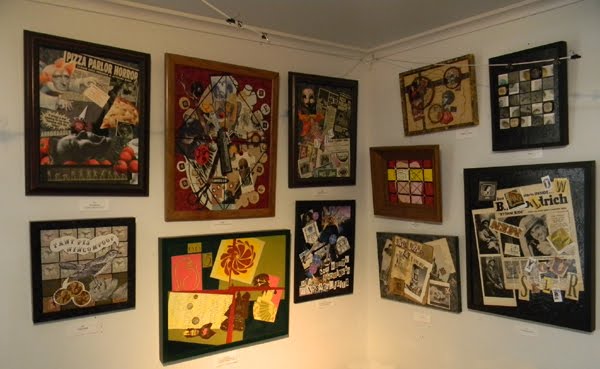
In celebration of my 15th anniversary in business we had Art on the Lawn at Anita's Beads last Saturday. I brought out all of the collage pieces that were displayed in the house and made room for them in the two shop galleries. I am really enjoying seeing them hanging all together. The photos above show Gallery 1 working across the room from left to right.

Most of the new work is hanging in Gallery 2. I even took "Blanche Big" from its customary place at the bottom of the front stairs.


Saturday, July 9, 2011

Marbled Paper


I've been collecting marbled paper for a while with the intent of using it for collage. It started with marbled endpapers in old books from the dump. And I bought some incredible hand marbled paper from Chena River Marblers out of Amherst, Massachusetts. I have a sheet like the fantastic multicolored one, and also the gold one shown on their home page.

But what prompted me to begin this post was the discovery of these fabulous marbled paper images from a really interesting site called Sheaff: ephemera. Don't miss the artistic printing album. I love these red and green hands, and also this cool hand postcard advertising the New Hampshire Craftsmans Fair at New Hampshire's Mt. Sunappe State Park. There's even an anti-tipping hand.

And also this view of the interior of the Park Street subway station in Boston. And how about this combination of dots and postage stamps, or this cool body in a bottle!

And if you liked the body in a bottle, you will love the collages of Muharrem Cetin. along with each image is a series of detail views of the piece. It's a very simple but effective site and the work is very thought-provoking. The collage detail above from Cetin's piece titled "False Five" with marbled paper provided a nice tie-in to my original subject. Seeing it has made me decide to pull together some of my marbled papers tomorrow.

Wednesday, June 29, 2011

X-Dots for the Library


I just finished the posters for this years fundraiser for the Gafney Library. I made a collaged version on foam board for display in the library, and then I made a Photoshop version for printing and posting. I used some of my marker dots cut into quarters and rotated 45 degrees to form flashing white X's as the decoration.


This year there are 57 local artists donating their work which will be on display in the library for most of July. Raffle tickets are $1. so if you find yourself in Wakefield, take a chance!

Saturday, June 25, 2011

Two New Crosses


I never did finish my previous post. That list of Russian artists should have hyperlinks to pictures of their work. I got Internet Explorer 9 in the midst of it and then couldn't highlight and link in the compose editor. So I painfully set it up by doctoring the html only to find I couldn't publish or save. So now I am back in Firefox and things are back to normal.


Having no computer for a while was actually good for me. I had fun drawing and cut a path in the back yard which I will photograph for my Temporary Blog. I made good use of one of my crosses as an hours advertisement for my bead shop.


I wish I could put it on my websites but my Front Page will not run on Windows 7. But aside from that, and no longer having MSWord, everything else is pretty much back to normal. I'm enjoying the speed of my cable and, to get back to the Russians, I found a bunch of cool YouTube videos on Kandinsky and El Lissitzky that I will make the subject of a later post.

Thursday, June 23, 2011

Constructivism and the Visual Verities

I've just begun reading George Rickey's book Constructivism: Origins and Evolution (Revised Editon; NY: George Braziller, 1995) which I purchased some time ago at the Museum of Fine Arts bookstore in Boston. I wasn't into collage yet but look at those dots on the cover! Even back then they held an attraction for me.

The term "Constructivism" was invented c.1914 by Russian artist Vladimir Tatlin to define objects built rather than cast or carved, or any design in two or three dimensions reminiscent of Euclid: flat and rectilinear or made with straight edge or compass.

The constructivists (1913-1922) include some of my favorite Russian artists: Tatlin, Malevich, Rodchenko, El Lissitzky, Naum Gabo, Antoine Pevsner and (briefly) Wassily Kandinsky.

In the preface to the revised edition, the author presents this list of visual verities ". . . waiting like the keys of a piano for a human touch:"


Time

Space

Color

Light

Texture

Contrast

Passage

Impact

Echo

Void

Shape

Acute

Obtuse

Convex

Concave

Sound

Silence

Wednesday, June 22, 2011

New Cross Block


My new internet cable was installed this morning. I have a few problems that hopefully will be solved by the new connection speed, and then things will be back to normal, a newer,*faster* normal!


I can upload images to my blogs again. Hooray!

Friday, June 10, 2011

Incommunicado

My computer is dying. So I will be absent for a while until I can get a replacement. I can be reached at 603-522-6529 (sorry, got that wrong the first time - typo corrected!) and my shop is open 10-5. I will be open 7 days during July and August; otherwise closed on Tue & Wed. Hope to be back soon. -Anita

Tuesday, June 7, 2011

Ten Crosses


I'm having so much fun with these marker drawings. Last night I did a bunch of them. I started making them larger and ended up having to piece a couple of them together from two images as they were too large for the scanner. I will play further with some of these to see what they will do when repeated.

Here is number 10:

Tuesday, May 31, 2011

Big Sur


Recognize this?


I think the heat has got to me today! This needs color.

Monday, May 30, 2011

Fowlie's Age of Surrealism


I've had Wallace Fowlie's Age of Surrealism (1950: The Swallow Press and William Morrow) on my shelf for a while, having found it a few years ago at the dump. In it there are some very thought-provoking passages.
The word surrealism . . . has one closed and confining use to describe the artistic movement centering in Paris in the years between the two World Wars, 1919-1939. In the 20's and the 30's, surrealism was an organized movement, iconclastic and revolutionary in nature, with its leaders and disciples, its manifestos and publications, its exhibitions and even its street brawls. It became international during those years to such an extent that fourteen countries were represented in its 1939 exhibition. But surrealism has another meaning, perhaps even an eternal meaning, and a context far wider than that of the Andre Breton group which chronologically succeeded dadaism about 1924. . . The importance and the seriousness of surrealism equal now the seriousness granted the other two contemporary movements of communism and neo-thomism. These three "revolutions" seem to be the most important for an understanding of our modern world, and although they appear to us now of almost equal importance, I shouldn't be surprised that in time surrealism, because of its subtle alliance with communism and the problem of spirituality, will grow into its real stature of the most vital and renovating movement of modern thought and art. [pp. 11-13]
Fowlie then places surrealism "beside the two words 'classicism' and 'romanticism' which for so long have been the cause of controversy and definition in Western art."
The immediate words which come to mind when we think of classicism are order, control, condensation, choice, synthesis, rules. The classical movement is that one when the artist is faithful not only to the rules of his art, established by such an authority as Aristotle, but faithful also to the government of his political state. As an artist he is in accord with the moral, political and aesthetic beliefs of his society. [p. 14]
Romanticism, according to Fowlie, is the opposite of classicism and as such is associated with revolution and liberation.
The classicist is closely bound up with society and the romanticist is the artist quite alone and apart, the individual who is opposed to society and who finds the rules for his art in himself. In its highest sense, romantic art is created by a single artist, as opposed to classical art which is created by a society. [p. 14]
Surrealism follows from romanticism in its belief in the autonomy of the artist, along with his isolation and uniqueness. The surrealists extolled automatism or automatic writing:
. . . as being the legitimate method of the creative artist. To seek in oneself, on all the various levels of consciousness of oneself, the rules and the form of one's art is the romantic method, but it is also the surrealist method. [pp. 14-15]
Fowlie explains that the conscious state of man is not sufficient.
His subconscious contains a larger and especially a more authentic or accurate part of his being. It was found that our conscious speech and our daily actions are usually in contradiction with our true selves and our deeper desires. The neat patterns of human behavior, set forth by the realists. . . were found to be patterns formed by social forces rather than our desires or temperaments or inner psychological selves. This discovery or conviction that we are more sincerely revealed in our dreams and in our purely instinctive actions than in our daily exterior habits of behavior. . . is of course basic to surrealism. . . A new kind of absolute is in sight, which, although it contains a refusal of what we usually call logical intelligence, it is an elevation of the subconscious of man into a position of power and magnitude and (the word now forces itself on us) surreality. [pp 16-17]
There are chapters on various surrealist writers, poets and playwrights (Lautreamont, Rimbaud, Mallarme, Apollinaire, Breton, Cocteau and Eluard, the friend of artist Max Ernst) followed by a chapter on the art of Picasso.

Interesting to note that the volume passed through the hands of two Manchester, New Hampshire booksellers.


Here's a bit on solitude which I found to be particularly interesting:
The word most often used to describe the romantic temperament is individualism. The romantic is generally considered the type of artist who has broken the rules and constraining bonds of an established order. . .But before attaining to this experience of himself, the romantic has had to go through a longer, and I believe, a far more significant experience which is that of solitude--a very particular kind of solitude which results in forming the prevailing temperament of the great modern artists. . . each one had to become a new and unique solitary hero, discovering in his own conscience and his own memory the subject matter of his works. The experience of solitude probably explains more about modern literature and art than any other single experience. In his solitude, which is his inheritance, the modern artist has had to learn that the universe which he is going to write or paint is in himself. . . The romantics held this belief partially and intuitively. The surrealists make it into a creed and a method. [pp. 26 & 29]
And this statement on the intrusiveness of the new media made me wonder how the surrealists of that time would react to television's ubiquitous presence in restaurants and Wal-Marts!
They were tired and disgusted with the literary eloquence and verboseness of the 20th century. Their age had become a verbal nightmare for them. The radio, with its perpetual flow of words, was converting the world into a delirious cacophony. The language of man was being prostituted and degraded as it had never been before. [p. 105]

Saturday, May 28, 2011

Listening to Chomsky

I filled a whole sketchbook page with marker doodles while watching Noam Chomsky: Rebel Without A Pause from Netflix. The nice thing about Chomsky's presentations is you really only need to listen. Noam Chomsky, born in 1928, tops the list of people I admire and I wonder who will step forward and continue his great work when the time comes that he is no longer with us.


Alex Steinweiss Album Cover Art


I just discovered a wonderful graphic designer named Alex Steinweiss who was responsible for the invention of album cover art in the late 1930's. Here's a bit of history from the Alex Steinweiss site:
Before Alex Steinweiss invented the album cover in 1938, at the age of 23, all albums came in plain brown wrappers. Steinweiss's idea to create a package that had something visual on the outside to lure the consumer was a huge success. That simple idea revolutionized the record business and spawned an entire new field of illustration--album cover art--that is now inseparable from the product it announces. Steinweiss's covers are still regarded as icons of the genre. He designed them as miniature posters, with eye-catching graphics, distinctive and vivid colors, and creative, original typography. He was an accomplished illustrator, and he incorporated original artwork into most of his pieces. The Steinweiss style went hand in hand with the golden age of jazz, classical, and popular music.

Follow this link to the Steinweiss covers page which has over 70 examples including the one with a cool collage treasure dot shown above. My first LP was "Rubber Soul" by The Beatles. I miss that large 12x12 format. Today's CD's are too small to do their artwork justice, but I guess that's progress for you.

Taschen has published what looks to be a great book on Steinweiss. There is also a biography, For the Record: The Life and Work of Alex Steinweiss on Amazon.