Sunday, December 6, 2009

Player Piano


Here's another Salem News article from my scrap book about the old player piano that my father (Fred, not "Frank") modified to run automatically with the help of an old vacuum cleaner. (See related article, The Piano Girl, about an old photo that was found inside.) The suction was a bit too strong so the music played LOUD! You held your foot on the soft petal to spare the neighbors when the windows were open in the summertime.


Grandmother's House in Salem


My grandparents owned this lovely colonial house on 29 St. Peter Street in Salem, Massachusetts and lived there from June 10, 1943 until May 20, 1969. Parker Brothers and the Salem Jail were just down the street. It was slated to be torn down as part of "urban renewal" in 1969. The land was taken to create Almy's parking lot. Not a great improvement in my estimation.


After they sold their house in Beverly, my parents (and I) lived with them for six months or so while a new house in Danvers was being built. I was four years old and I remember it as one of the best times of my childhood. I was given the little back bedroom with the slanted wall on the third floor (the sleep-over room) as my very own for the duration.


My Aunt Dell and Uncle Al were living in the apartment on the first floor and I would sneak down the back stairs connecting the two bathrooms to watch my aunt cook (everything she made smelled wonderful) and chase after her siamese cat, Dozo.


These old Salem News articles are from my scrap book. Some day I will have to visit Kimball Court to have a look for old times sake.

Below is my grandmother's kitchen. The stove stands in front of one of four blocked-off fireplaces. Another was in their living room, and two were downstairs in my Aunt's apartment. All had deep closets on either side. (The closet on the left in the living room was the candy closet.) Perhaps there was a fifth fireplace in my grandparents' third-floor bedroom. I can't recall now.


31 Cabot Street, Beverly


The box of photos that I went through last night had some pages from my old scrap book. Included was the listing for the house my parents owned when I was born. (More about the house in a previous post about Beverly, Mass.)

Here's a shot of the house before they purchased it. It looks like it was taken from inside a car parked nearby.


And here's a couple of later shots, one from the same vantage point as "before" and one of the back, after renovations. There was a beautiful spiraling staircase in the front entrance hall leading to the second floor. And the dark attic was scary and fascinating at the same time. It had a tiny hidden room behind one wall that my mother referred to as a "Money Closet."


Saturday, December 5, 2009

First Collage Circa 1970


Here's my old room in my parent's house in Danvers with my first collage on the walls. It was done back in the days when I had no clue what collage was! (Same cat pictured twice; I forget its name now.)

Oh Look, It's the Nylon Lady!

So nice to find the same photograph that I used in my collage titled "Easy to Adjust." I think my attraction might be due to the fact that she resembles my mother.

Perry's Nut House Re-Visited


These photographs were taken on the second floor of Perry's Nut House (postcard views here) probably around 1990 or so.

Take Your Own Picture


Are these "Take Your Own Picture" booths still around? I haven't seen one lately! It took a while to locate these photos which were taken in the machine at Salem Willows. These are of my daughter and me, back in the early 1980's:


And here's a couple of my sister and her best friend Laurie:

Tuesday, December 1, 2009

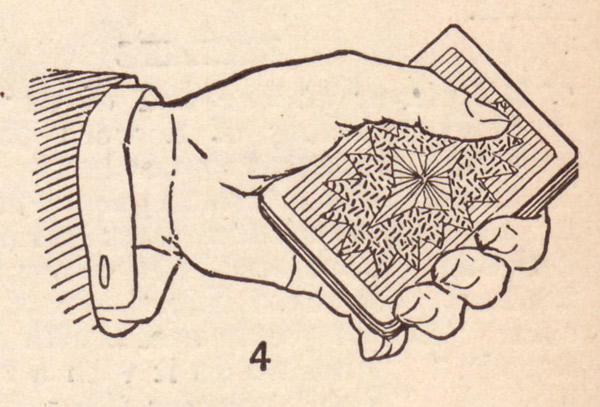
How They Do That


The mystery solved, thanks to the 1923 Book of Knowledge. Very nice hands, playing cards and numbers.


Things To Do

I recently added a Subject Index right below the Blog Archive, and added a few new labels including All My Favorites 2008 and All My Favorites 2009.

Other additions: Methods (how to) and Triangles.

I can see where there is room for improvement here. Sixty three posts labeled "Artists" seems cumbersome and vague. I'll have to work on fixing that.

Here is another cool page from the 1923 Book of Knowledge:

Making paper boxes is a fun thing to do at holiday time!

Monday, November 30, 2009

Anyone Can Play


From the Book of Knowledge 1923, Volume I.
We have all seen this Magic Kingdom, which is in nearly all our homes. We call in the Piano. Whenever I am there, I am so happy that it makes me want to show you the way, and help you to understand all the beautiful things which the Fairies whispered in the days of long ago.

Sunday, November 29, 2009

Best of BoK Volume Nine


These first two plates illustrate an article titled "The Color of the Stars."

The fine print on THE LIGHT THAT EXPLAINS THE STARS TO US reads as follows:
When pure light, as from a white-hot iron, passes through a glass prism, it is broken up into seven colors, called the spectrum, as shown in the first picture. But light from the sun shows, in addition to the colors, various lines, as seen in the second picture. These lines are caused by some of the different substances that compose the sun. Although here we see only a few lines, the sun's spectrum really shows over 2,000 lines. The third picture is the spectrum of a star, Sirius, and when compared with that of the sun, it shows that the stars are made of the same materials as the sun and earth, because the lines in the spectrum for different substances always appear in the same position in relation to each other, as can be seen by comparing these spectra of the sun and Sirius. Although the spectrum color of the metal sodium is yellow, as in the fourth picture, this appears dark in the sun and star spectra, because of the intense light behind it, just as a gas-jet seen in front of the sun's disc appears black; but of course sodium is in the same position in all the spectra.

And HOW THE STAR LIGHT TELLS US OF WHAT THE STARS ARE MADE says:
This picture shows us how the spectroscope is used to enable men to catch the light of a star, and by passing it through a glass prism to bread up the light into various colors. As different metals give off different colors, we can in this way tell of what the stars are made. Ths picture does not show the spectroscope, but illustrates the principle.

This last illustration, A WHEEL A QUARTER OF A MILE ROUND, reminds me of a postcard that was posted recently for Postcard Friendly Friday. The caption reads:
Some of you have seen this gigantic wheel which used to be at Earl's Court in London. This was not the first great wheel to be built. An American engineer, Mr. G. W. Ferris, had seen those curious little upright roundabouts that come to the country fairs, and he thought out the idea and built for the World's Fair at Chicago a big wheel of iron that carried 1,440 people at one time. Then the Earl's Court wheel was built, and this was much more wonderful that the other. It was 300 feet across, and the towers that supported it were 175 feet high. The axle, weighing 54 tons, was hollow, and people could walk through it from one side to the other while the wheel was going round with its 1,600 passengers. The great wheel was turned by a big engine that needed only one man to work it.

The Politics of Timothy Leary


The mushroom plate was a nice lead-in to this second extraordinary find: The Politics of Ecstasy by Timothy Leary (NY: Putnam, 1968).

I was a freshman in high school when it was published. The endpapers are pretty interesting.


1923 Book of Knowledge


I still haven't put the volumes in numerical order to see if the set is complete. I found a few volumes of this set before over the years and removed numerous color plates and b&w photos for my clipping files. I will save this set intact for reference, scanning and blog posting. . . more to come!

Friday, November 27, 2009

Post Holiday Postcards

These two paintings from the collection of The Art Institute of Chicago have been reproduced as part of a set of art postcards from a game called Masterpiece: The Art Auction Game. Above is Thanksgiving ( c. 1935) by Doris Lee.

And this is Peter Blume's The Rock (1948). Hope everyone had a nice Thanksgiving and is enjoying the left-overs on this Postcard Friendship Friday!